Jeffrey's answer
A good villain is a villain the reader does not want to lose.
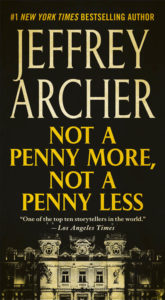
Pierce Brosnan once proved that to me with a phone call. He rang me about Not a Penny More, Not a Penny Less and said he wanted to play Harvey Metcalfe. He did not want to play one of the four young men trying to recover their money. He wanted to play the villain — the man who had robbed them. That is the public for you. They like the bad guys more than the good guys. They love reading about them. They love watching them. Of course, they also want to see them beaten in the end. But the journey is the villain. Villains, on the page or on the stage, are very often more fun to play than nice, sweet, delightful, good human beings. Shakespeare, of course, was a genius at this.
Othello is an amazing play because Othello is naive — and the play knows it. The genius of the play is Iago. I once saw Frank Finlay play Iago. Laurence Olivier described that performance as one of the greatest single things he had ever seen on a stage. Finlay told me himself that Iago was what he considered the greatest piece of work he had done in his career — and that the then Director of the National Theatre felt the same way. People forget that the part of Iago is one of the longest in Shakespeare. It is unrelenting. You have to hate the man. You have to want to kill him. He is just an evil piece of work. It takes tremendous acting for the audience never to take their eyes off him, and to remain frightened. The same is true on the page.
If you ask me whether there is one even better than Iago, I would tell you Cassius. Cassius in Julius Caesar is a more cunning piece of work than Iago. I saw John Gielgud play him. I couldn’t take my eyes off him. What an evil piece of work. And then I met Gielgud — and you couldn’t meet a nicer, more gentle man. That is part of why he was one of the great actors of my lifetime, and it tells you something about how a great villain is made: someone who can carry the weight of being hated for a hundred and fifty pages, and still hold the reader’s attention to the last line.
Look at Catch Me If You Can. Leonardo DiCaprio plays Frank Abagnale, the conman. Tom Hanks — who is one of the nicest people on earth, and that is his problem in this film — plays the FBI man chasing him. You want DiCaprio to win, despite the fact that Tom Hanks is one of the nicest people on earth. That is what makes the film. If you wanted the wicked DiCaprio to lose and you didn’t like him, the film wouldn’t work. You have to go for it. Modern films and modern books are heading further and further in this direction.
Harvey Metcalfe came out of my anger after I had been swindled in 1974 of every penny I owned. I did not want to write a man who twirled his moustache. I wanted a man who believed he was entitled. Entitled to win. Entitled to profit. Entitled to treat other people as stepping stones to whatever he wanted next. He is not a monster. He is, far more dangerously, a man you have probably worked for. The moment Pierce Brosnan told me he wanted to play him, I knew the book had got him right.
Three rules I have followed for fifty years.
One — give your villain a competence the protagonist lacks. Charm. Intelligence. Money. A genuine talent. Without competence there is no threat.
Two — give your villain a moral framework. They have to be able to explain to themselves why what they are doing is justified. The reader does not have to agree. The reader has to be able to follow the logic.
Three — never let the villain be aware that they are the villain. The moment they begin to enjoy their own wickedness, they become a cartoon. The Harvey Metcalfes of the world are not having fun. They are doing what they believe must be done. That is what makes them frightening. And that is why the public wants to read about them.
A few practical notes
- Give them a coherent worldview. The villain must be able to explain, to themselves, why they are right. Pure evil for evil’s sake reads as cardboard.
- Make them competent. A villain whom the protagonist easily outsmarts produces no tension. Iago. Cassius. Harvey Metcalfe. All formidable.
- Give them charm. The most frightening villains are the ones we can imagine liking. Hannibal Lecter is courteous. Tom Ripley is plausible. Frank Abagnale in Catch Me If You Can is the man you wanted to win.
- Don’t let them know they’re the villain. The moment a villain begins to enjoy their wickedness, they become a cartoon.
- Give them a relationship the reader recognises. A villain with a daughter they love, a wife they betray. The reader sees a real person doing terrible things.
- Avoid the redemption arc unless you’re committing fully. Half-redeemed villains satisfy nobody.
- Test: would the villain be a useful colleague at work? If ‘yes, but I’d watch my back’ — you’ve got the right villain.
Read Iago aloud. The longest part in Shakespeare and the model for every great villain since. The unrelenting quality is what holds the audience. Same on the page.