- More
- Back
If you read Part 1 of this list you will have met the ten classic detective novels that built the genre before 1980. Wilkie Collins. Conan Doyle. Hammett. Chandler. Sayers (twice). Simenon. P.D. James. Colin Dexter. Ellis Peters. Without them, none of what follows would exist.
But the genre did not stop in 1980. It accelerated.
Robert Goddard reinvented the historical-mystery in a holiday cottage in Devon. Ian Rankin gave us Rebus. Michael Connelly gave us Bosch — and made the American police procedural a literary form for the first time since Chandler. Lee Child gave us Jack Reacher and proved the modern thriller still had a brand-new shape in it. Alexander McCall Smith, of all places, set a detective agency in Botswana — and proved that you can write detective fiction without a single car chase or corpse on page one. C.J. Sansom took the form back five hundred years and made the Tudor monasteries the most dangerous setting in modern crime fiction. Stieg Larsson, a Swedish journalist who never lived to see his own success, gave us Lisbeth Salander — and changed what a female lead in a detective novel could be. Anthony Horowitz wrote the only modern Holmes pastiche worth reading. J.K. Rowling, writing as Robert Galbraith, gave us Cormoran Strike. Peter Swanson wrote one of the great twenty-first-century thrillers in his second novel. And Richard Osman, of all people, sold ten million copies in five years by writing the funniest cosy-crime novel of the century.
These are the eleven modern detective novels I have found impossible to ignore as a reader – yes I couldn’t keep it to 10. When I sat down in 2019 to write my own detective series, the William Warwick Novels, I knew as a writer, I had to learn from them.
I will tell you almost nothing about the plots. The detective novel ruined in advance is the detective novel I have stolen from you. So: dates, authors, the shape of the book, and why it earned its place.
Sir John Major recommended this book to me twenty-odd years ago, and I have not forgotten it.
If you want a wonderful weekend, Robert Goddard will give it to you.
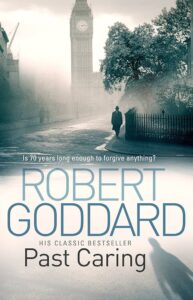
Past Caring was Goddard’s first novel — and first novels are not always exceptional, but this one is. It is a wonderful story about a historian who has to look into the rather mysterious life of a cabinet minister many years ago, and comes up with the most amazing story. The historian is Martin Radford. The cabinet minister is Edwin Strafford. The year of Strafford’s mysterious political disappearance is 1910. And the journey takes Radford from Madeira to England by way of an extraordinary love story and a much darker family secret.
What Goddard does, and what most modern crime writers no longer attempt, is to combine a genuine historical investigation with a contemporary detective frame. Two narratives at once. A long-dead cabinet minister’s story, told through his discovered diaries; and a present-day historian uncovering it, with everything that means for him personally. It is patient, well-researched, and emotionally clever in the way the best detective fiction always is — by the time you understand what happened in 1910, the historian has been changed by the knowing.
Goddard has now written more than thirty novels in this register. Past Caring remains the best place to start — and the one I keep coming back to. I really would commend you to read it.
If you like a detective novel that takes its history as seriously as its mystery. Goddard does both.
Available from Apple BooksBookshop.org
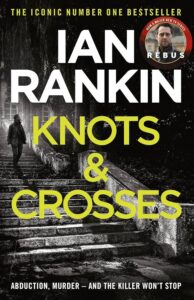
The first Inspector Rebus novel. Tartan noir was about to become a category. Rankin — twenty-six years old, writing in Edinburgh — was about to become its head boy.
Rebus is a copper. He drinks too much. He smokes too much. He listens to too much rock music. He has a daughter he barely sees. He works in an Edinburgh that, in 1987, was the city tourists did not visit — a city of housing estates and unsolved cases and history that hurt. And the case in Knots and Crosses is, in a way Rankin’s later books would refine and never quite repeat, personal.
Ian Rankin quite recently and quite rightly received a knighthood — showing that people did take his novels not just as detective novels. He had in common with so many intelligent writers that he stuck to what he knew. He knew Edinburgh backwards. Street by street, shop by shop, house by house. So when you read an Ian Rankin, you are there. You are in Edinburgh. You are walking down the street with him. For all of us who have seen Edinburgh, it brings back memories.
The great writers bring their background and home — in the way Poirot talks about Belgium and not being French; the way Conan Doyle is in Baker Street. It’s a great thing to give the reader something to attach themselves to. For Ian Rankin, it’s Edinburgh. He must have had the most amazing contacts in the Scottish police force to have got those stories. But on top of being a damn good writer, he is a damn good storyteller.
What Rankin proved, twenty years before BookTok turned regional crime into a global category, is that a city investigated by a single detective for long enough becomes a literary character in its own right. Edinburgh in Rankin’s hands is what Los Angeles is in Chandler’s. It is the case behind every case.
Available from Apple BooksBookshop
The first Harry Bosch novel.
Michael Connelly, like Rankin, sticks to one city: Los Angeles. Probably one of the biggest crime cities on earth, so he won’t be short of stories ever.
Connelly was an LA crime reporter before he was a novelist. It shows. The Black Echo opens with a body in a drainage pipe, moves through the LAPD bureaucracy with the precision of a man who has filed every form, and arrives at a conclusion that is also — almost incidentally — a meditation on the Vietnam War. Connelly has now written more than thirty Bosch novels. The first remains, for many of us, the best.
There is always a problem for major detective writers. They go on, sometimes, for too long. But that is the job they do, and they do it brilliantly. Their readers love them. The classic example is Poirot. Agatha Christie’s Poirot. I hate to tell you, in his last novel, he was 142. The truth is, no one had noticed that he had gone from the days when he was a young detective through to where he was — and he was 142. Because Agatha Christie shut up about that, and she just went on writing about him.
What Connelly did, and what almost no other modern American crime writer has matched, is to make a procedural feel like a personal investigation without losing the procedural. Bosch is a man with a code. The LAPD is a system. The friction between them is the engine of every novel.
This is a detective novel that feels like the inside of a real working police department. Reading Bosch is the closest you will get without actually being there.
Available from Apple BooksBookshop
The first Jack Reacher novel.
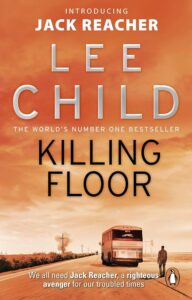
Reacher is an ex-military policeman, six foot five, with no fixed address, no possessions to speak of, no phone, and no plan. He drifts off a Greyhound bus into a small town in Georgia, walks into a diner for a cup of coffee, and is arrested for murder before the coffee arrives. That is the opening of Killing Floor, and what Lee Child understood at the start of his career — and which he has never since lost — is that the opening of a thriller has to land.
I wonder how he gets away with it. The same character every time, doing it every time, and he sells more books than anyone else. Do you know why? He’s a damn good storyteller. And people, once they’ve found someone they love, stick with them.
Twenty-eight Reacher novels in. Tom Cruise played him in two films. Alan Ritchson plays him on Amazon Prime now. Both adaptations work in their way. The novels are better.
There is one thing series detective writers offer their readers that stand-alone novelists never quite can. They know he’s going to be in the next book, so he isn’t going to die at the end. You don’t have that problem. He will survive and he will be in the next book. That is its own kind of contract — between writer and reader — and Lee Child understands it better than anyone working today.
If you want a thriller that you finish at one in the morning and then immediately start another – Reacher is the guaranteed to deliver.
Available from Apple BooksBookshop.org
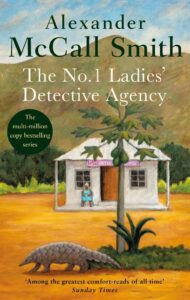
A traditionally built lady, in Botswana, opens a detective agency.
I will defend this book to anyone. It is gentler than Connelly. It is shorter than James. It does not contain a single car chase, very few crimes that would interest the Crown Prosecution Service, and a great deal of bush tea.
I found The No.1 Ladies’ Detective Agency great fun. Mma Ramotswe is every bit as observant as Poirot. Very cunning. The setting is Botswana, which in itself was interesting, and brings an African flavour. I go back to boring you by saying: if you can bring a local flavour in, it always helps. Because you learn. People love to learn something when they’re reading without it being thrust down their throats. I try very hard to throw in facts and almost lose them on the page as part of the deal.
I never had the privilege of meeting Alexander McCall Smith. But when I was in South Africa, I did have the privilege of meeting the Nobel Prize winner Nadine Gordimer. I sat with her for tea in Cape Town. I said, “I must congratulate you on your Nobel Prize. What an amazing achievement.” She said, “Jeffrey, I’d give it to you now for your sales.”
What McCall Smith did was to remind the genre that detection does not require a corpse. Most of Mma Ramotswe’s cases — missing husbands, suspect employees, rumours about a neighbour — are the cases an actual private detective would take. Most crime novels skip past them. He stopped, sat down with them, and made an entire literature.
Available from Apple BooksBookshop.org
The thing about detective writers — Wilkie Collins, not so much Conan Doyle, but certainly Dorothy Sayers — is they come in and out of fashion. It doesn’t mean they’re not damn good at their job. It’s just that fashion does move on. Unless you are Charles Dickens, unless you are Conan Doyle, it’s damned hard to survive.
Some of the writers above this paragraph are at the height of their fashion right now. Some of those below are not — though they should be. Read them anyway.
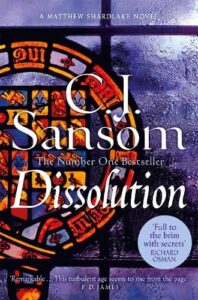
C.J. Sansom died in April 2024, and I think he was one of the most unsung writers of the last fifty years.
His detective is Matthew Shardlake — a hunchback, a lawyer — working in Henrician England. Unlike so many authors who fall apart or are not quite as good or keep repeating themselves, C.J. Sansom is an outstanding novelist who keeps you reading. Across the seven Shardlake novels he wrote in twenty-one years, the cases move through Cromwell’s England, the dissolution of the monasteries, Cranmer, and into the reign of Edward VI and the early reign of Elizabeth I. Princess Elizabeth, when there are a lot of people who don’t want her to become queen, relies on him to advise her. Half the time the aristocracy is against him, because he’s representing the other half of the aristocracy — which he does absolutely brilliantly. He has an incidental wife. He has assistants who are not up to his standard.
I only met him once. He was a friend of Eddie Bell’s — Eddie was a huge admirer, which is how I discovered him. We were published by the same publisher. I remember with horror once, ringing Eddie and saying, “You’ve got us out in America on the same day.” Eddie said, “Jeffrey, he doesn’t sell in America.” He’s another classic example of a brilliant English author who does nothing in the United States. That is, I think, less the writer’s failing and more the marketplace’s. Sansom was as English as Trollope. American readers were never going to find him in the numbers he deserved.
A four-part Disney+ adaptation, Shardlake, starring Arthur Hughes, was released in 2024 — the year of his death.
If you’ve not read C.J. Sansom, you’ve got a thrill ahead of you. Start with Dissolution and you will read all seven. He is among the best I have ever read.
Available from Apple BooksBookshop.org
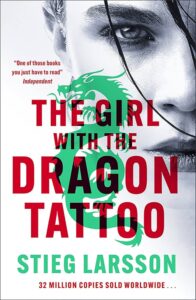
Stieg Larsson broke all the rules. And while breaking all the rules, just shot to the top of the bestseller list right around the world.
Larsson was a Swedish journalist who had spent thirty years investigating right-wing extremism. He sat down to write three novels, delivered all three to his publisher, was paid for all three, and died of a heart attack at fifty before any of them were published. He never saw a single copy. The trilogy has now sold over a hundred million.
He had an immense disadvantage which all writers whose first language is not English have. He first had to break the language area. He comes out in Sweden, but we British and Americans can only read the translator. So he relies a lot on the translator — and I’m bound to say he must be good, otherwise he wouldn’t have sold millions of copies.
But the genius is Lisbeth Salander.
His genius is that the girl is singularly unattractive. She’s unattractive in every way, both physically and as a human being. But you feel for her because of her very sad background, and you feel for her because of the way she’s been brought up. She’s not had a fair start in life. But you realise she has a particular genius. Our hero takes advantage of that genius and uses her. I think it’s an amazing trilogy.
The 2009 Swedish film with Noomi Rapace, and the 2011 David Fincher version with Rooney Mara and Daniel Craig, are both worth your time. I quite enjoyed the films. They were quite good. But this was, for me, a classic example: if you thought the books were good, and the films were good, you should read the books. They’re better.
Available from Apple BooksBookshop.org
Anthony Horowitz drives me mad.
He is a dear friend, and he drives me completely bonkers because you can never tell what he’s going to write next. Anthony Horowitz is extremely versatile. Awarded the CBE — you will live to see him get a knighthood, I won’t. Close friend of the royal family. He plays his cards brilliantly. But in my view — and I’ve told him off for it — he does too many genres. He does books for young people aged 14, 15, 16. He does detective stories. He does everything. And his television series Foyle’s War is brilliant — Detective Chief Superintendent Christopher Foyle is a wonderful character who is genuinely original.
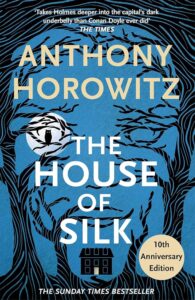
But it is The House of Silk that earns him his place on this list.
The Conan Doyle estate commissioned Horowitz to write a Sherlock Holmes pastiche. He produced one and then another (Moriarty, 2014), and refused all subsequent requests. He captured it, didn’t he? He captured it, which is so clever. By page 30, you think you’re actually reading Sherlock Holmes. That takes some doing. It is, by general agreement, the best of the modern Holmes pastiches — and arguably the best thing Horowitz has ever done.
He also took on James Bond, with three Fleming continuation novels. You have to be chosen to do Bond. I was approached casually — I can’t pretend I was approached formally and turned it down. I don’t want to do that sort of thing. He’s done that. Several other distinguished authors have done that. In my view, none of them have quite succeeded.Fleming is the harder challenge. Fleming lived in the spy world during the war. He knew everybody. He was a society writer, really. People were amused by the fact that he did writing on the side. That voice is harder to inhabit than Conan Doyle’s — and even Horowitz, the most able pasticheur of his generation, finds Bond a more demanding fit.
Horowitz is a great writer, but he can’t make his mind up what he’s doing next. When I last had lunch with him, he was doing three books at once.
I begged him to write another Sherlock Holmes. I said, “What I would do, Anthony, is say you bought this house and to your shock and surprise, you discovered six manuscripts in the bottom of a drawer with Dr Watson’s signature on them. And now you’re going to make a fortune just publishing them!” So, get on with it, Anthony. But he refused to do that and wrote another Rider book.
If you think a modern Holmes pastiche is impossible. House of Silk is the proof it isn’t.
Available from Apple BooksBookshop
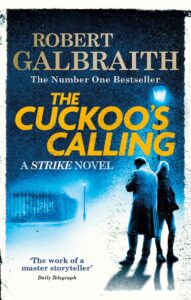
J.K. Rowling, writing under a pseudonym, published a private-detective novel set in modern London. For about three months, almost nobody noticed. Then The Sunday Times got an exclusive — “We can tell the world that Galbraith is in fact J.K. Rowling” — and of course she went to number one overnight – she quite rightly has a huge legion of fans.
Cormoran Strike is a one-legged ex-military investigator with a flat above his office and an assistant, Robin, who is rapidly becoming the most fully realised investigative partner in modern crime fiction. The case in The Cuckoo’s Calling— the apparent suicide of a supermodel — is the kind of plot that, in lesser hands, would be a beach read. Galbraith makes it a serious novel.
The fascinating thing with J.K. Rowling — because no one can doubt her skills as a storyteller, quite remarkable, and she will live on for ever — is that suddenly she decided to write a detective novel. And I loved it, by the way. Her detective is a drunken, brawling man who poses as an idiot when he’s really very bright. But luckily he has a secretary, a woman, who is very bright and keeps him on the straight and narrow.
I do have one small personal problem with the Rowling books — and it may be me. They’re too long. I can’t take 700 pages for a detective novel. Certainly Agatha Christie, at the other extreme, writes Poirot books and Marple books that are pumped up to 180 pages and shouldn’t be — they are novellas. With Christie, I can handle it because you can read it in a few hours. But Galbraith — it’s a lot of time to read a detective novel – but that’s what many fans will want – more, more, more.
What Galbraith reminded the genre is that the well-worn pieces — the office above the pub, the partner across the desk, the missing-person case that is not what it seems — still work, when handled by a writer who actually knows how to write a sentence. Most pieces in genre fiction are well-worn for the same reason most furniture is. They hold the weight.
If you think a famous author writing under another name is a marketing trick. Read the book. It is a fantastic detective book – with a great set of characters.
Available from Apple BooksBookshop.org
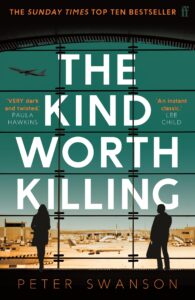
A man at an airport bar tells a stranger — a young woman with red hair — that he wants to murder his cheating wife. She offers to help. They sit next to each other on the same flight to Boston. What happens next is one of the tightest psychological thrillers of the twenty-first century.
I came to Swanson late. It’s about a man who meets this girl at an airport with red hair. I always wondered when I read that line — because an author is always looking for the clue that will give everything away — is the red hair going to be a clue? That is the kind of question only a writer asks while reading. And the kind only a very good writer makes you ask while turning the pages.
He holds you in suspense. You wonder what’s going to happen next, and you’re not absolutely sure right to the very end. He has the ability in that — but it’s a one-off and very rare. Damn good.
I thought he was about to have a brilliant career, and he couldn’t — because that book was in a class of its own and he’s never done it since. But it’s a bloody good book. Well worth a read.
Swanson has written ten more novels in the years since, and they are good — Eight Perfect Murders (2020) is genuinely accomplished, and Every Vow You Break (2021) keeps the pages turning. None of them, for me, has quite reached the level of the airport-bar opening of this one. It was a book that turned me into a fan.
The Kind Worth Killing found a new plot, one nobody had used. Twist by twist, page by page, all the way to the last line.
Available from Apple BooksBookshop
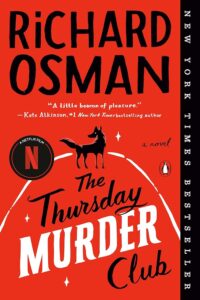
Richard Osman is a television presenter. He spent twenty years on British screens before he sat down to write a detective novel. The Thursday Murder Club — which features four pensioners in a Kent retirement village solving cold cases over Tuesday lunches — sold ten million copies in five years and triggered the largest cosy-crime boom of the twenty-first century.
The book is funny. That, more than anything, is the thing other detective writers have not quite understood about Osman’s success. The Thursday Murder Club is, on every page, amusing. Not silly. Not arch. Genuinely, observationally funny — about old age, about marriage, about English life — in a way most crime fiction never bothers to be.
What Osman has done for the genre is to remind it that the detective novel is, at its root, an entertainment. The Sayers tradition wanted it to be literature. The Hammett tradition wanted it to be moral protest. Both are legitimate. So is the Osman tradition: to be, on a wet Tuesday in February, the most pleasant possible thing to read. There is no shame in that. There is enormous skill in it.
If you have not yet read him. Start here. You will read all four.
Available from Apple BooksBookshop.org
If I could have dinner with three detectives — Sherlock Holmes, obviously. It would be interesting to see his character. A drug-taker. Never sure about his sexual proclivities — all part of the genius of being interested in him. If one had a couple of hours with him, one might just get to know him better.
Poirot — slightly influenced by the fact that David Suchet and I were both at school together, so I’m sentimental about him, and he’s a dear friend. I’d love to see what Poirot was really like. He’d be great fun. And his getting English wrong the whole time — so clever and very well written.
Of the modern ones — if you can call him modern now — I’d like to meet Morse. My sort of guy. I really would enjoy his company.
The idea of Morse and Poirot and Sherlock Holmes being in the same room — I don’t think I’d do a lot of talking. I might ask the odd question, but it would be fascinating seeing those three together. What did they have in common? They were absolutely brilliant detectives without the proper training. In the case of Morse, you can say he had the proper training. But they had a gift. It is a gift to spot something that others don’t spot — that solves a crime.
If I could ask all three of them one question, I would ask: what is it you have that the others don’t?
Strangely, that’s true with every profession. The great Sir Magdi Yacoub — the leading heart surgeon on Earth — I was sitting at dinner with him one night, next to another great surgeon. I said to the other great surgeon, “Why aren’t you as good as Magdi?” And he said, “If I could tell you, Jeffrey, I would be.”
The three of those detectives don’t know why they’re so good — which is why they’re so good.