Jeffrey's answer
A book that people cannot put down has three things. A strong opening, so they want to go on. A strong middle, where you set the base of the story. And a strong ending, so they don’t put it down. And, if possible, a twist at the very end — which makes them gulp.
But — and this is the part most first-time novelists miss — they will not gulp if they see it coming. You have to tease them. You may need to give them a minor clue. But at the end, when they read the last line, they have got to gulp.
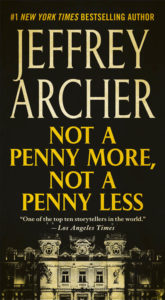
Forty-eight years ago, I wrote my first novel — Not a Penny More, Not a Penny Less. The 50th Anniversary Edition is published this August, and people who have just read the book are still ringing me to ask: did you plan that ending from the beginning? I am not, of course, going to tell you what the ending is — that would be unforgivable — but I will tell you about the craft of it, because the craft is the same in every twist worth writing.
The first rule, is this and it is older than me: the twist must come from inside the book, not outside it. A man you have never met cannot, on the last page, walk through the door and explain everything. The pieces of the twist have to be sitting on the board, in plain sight, from chapter one. The reader simply did not see how they fit together. When they fit, they have always fitted.
The second rule is the hardest. The twist must not be the point of the book. If the only reason the reader stayed with you for four hundred pages is the twist, the book has failed. The book has to work without the twist. The story, the characters, the prose, the ending — all of those have to satisfy on their own. The twist is the gulp on top. Take the twist away, and the book should still be a book worth reading.
If you can plant fairly, surprise honestly, and finish on a line that makes the reader gulp — they will close the book, sit there, and feel that they cannot quite breathe. Then they will pick the book up, turn back to chapter one, and look for the clues you hid. That is the moment, in a writer’s career, when the reader becomes a reader for life.
A few practical notes
- Plant and pay. The twist must be foreshadowed in chapters the reader thought were innocuous. The hidden plant is the craft.
- Hide the clue in the next sentence. Corlies Smith’s rule. Give the reader the clue, then immediately give them something more interesting to look at on the next line. They walk past the clue.
- The twist must change everything that came before. A real twist makes the reader want to re-read the book to see how the writer hid it.
- The twist must come from inside the story. A character revealing their secret, with reasons grounded in the story, is fair. A new character walking on at the end is not.
- Don’t telegraph the twist. Test by asking three early readers: at what point did you guess?
- Don’t cheat the reader. The reader knows what the protagonist knows.
- The twist is not the point. The book has to work without the twist. If readers stay only for the twist, you have a stunt, not a novel.
- Famous fair-play twists worth studying. And Then There Were None (Christie). The Murder of Roger Ackroyd (Christie). Atonement (McEwan). Gone Girl (Flynn). The Sixth Sense (Shyamalan). Each plants meticulously – and then perhaps one of mine – Not a Penny More, Not a Penny Less.
- Resource for the formal rules. Ronald Knox’s “Ten Commandments of Detective Fiction” (1929) — the foundational rules of fair-play that inspired many in my 10 Best Classic Detective Novels List. A twist that breaks them feels like cheating; one that respects them feels inevitable.