Jeffrey's answer
Miss Tredgold. The unlikely answer, and the honest one.
Miss Tredgold appears in The Prodigal Daughter, which is the sequel to Kane and Abel. I had not planned her as a major character. She was, in the original outline, a household appointment — a nanny brought on in chapter three to look after the heroine’s daughter — and she was meant to leave the book after fifty pages or so. By the time I reached draft two, she had taken up residence. By draft five, she was effectively running the middle third of the novel. By draft eight, I gave up trying to manage her and let her have what she had decided she was going to have.
She is, in many ways, the experience that taught me characters can have a life their author did not predict. I am, by inclination, a planner. I know the opening of every novel I write, I have a sense of the middle, I know the ending. I do not write blind. But Miss Tredgold arrived as a minor character and refused to be minor, and when I tried to write her out she resisted. The book was better for her insistence. I learned to listen to characters who refused to leave.
She also taught me something about discipline, which is perhaps the strangest lesson a character has ever taught me. Miss Tredgold is, in the book, a governess of the old school — punctual, exacting, kind in a way that does not announce itself, ferocious about the things she believes in, and entirely unsentimental about everything else. She runs her household, and the children in it, on a schedule. When I was writing her, I noticed that my own discipline at the desk sharpened. Some characters absorb you; you write better when they are in the room.
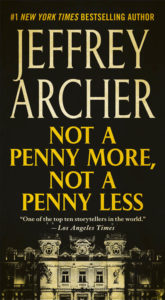
The runners-up, since you asked. Harvey Metcalfe in Not a Penny More, Not a Penny Less, because I wrote him in white-hot anger after being swindled, and he carries more entitled rage than any character I have built since. Sir Cedric in The Eleventh Commandment, because he is the closest thing I have written to a portrait of the Westminster I knew. William Warwick, because across eight novels he has become the most consistent friend I have on the page. And Florentyna Kane — because she is, in some ways, my wife Mary, fictionalised. Mary will deny this. I will deny it. We will both keep denying it, because that is what writers and the wives of writers do.
But Miss Tredgold is the answer. She is the character who taught me to listen.
A few practical notes
- Some characters arrive and refuse to leave. When a minor character takes more space than the writer planned, listen. The book usually knows what it needs.
- Track characters who surprise you. Most novelists report that one or two characters per book “take over.” These are usually the most memorable to readers.
- The author’s secret favourite is rarely the protagonist. Conan Doyle preferred Sherlock’s brother Mycroft. P. G. Wodehouse preferred Psmith to Jeeves. Christie famously tired of Poirot.
- Build characters in detail before chapter one. What they ate as a child. Who they loved at seventeen. What scares them. Most of this never reaches the page; all of it shapes the dialogue.
- The speaker-tag test. Cover the speaker tags in a draft. Can you tell who is speaking? If yes, the characters are real. If no, every character is the writer.
- Miss Tredgold appears in. The Prodigal Daughter (1982), the sequel to Kane and Abel.