Jeffrey's answer
I started writing Not a Penny More, Not a Penny Less in 1974, in a year that was, by any reasonable measure, the busiest of my life.
I had just been swindled out of every penny I owned in a Canadian investment called Aquablast. I had stood down from Parliament. I had lost the family house in The Boltons. My wife Mary had taken a teaching post in Cambridge, with two young sons, William, who was four, and James, who was two. And my sister Liz had moved in to help. I was knocking on doors for any job I could find, and being told, politely, that I was not wanted because I appeared too risky.
In the middle of all that, I sat down to write. Not because I had time. Because I did not.
The lesson I drew from that year, and I have applied it for fifty years since, is that you do not find time to write. You take it. There is no week in any adult’s life that is not, by someone’s definition, busy. There is no decade that does not have at least one crisis. The novelist who waits for life to calm down before they write is probably the novelist who does not write.
What you can do is be ruthless about the half-hour. Most people have a half-hour somewhere in their day that they are giving away, perhaps to television, to social media, to standing at the kitchen counter being mildly worried about something. Take that half-hour. Sit down. Write. Five hundred words a day for a year is one hundred and eighty thousand words. That is two novels.
You do not need to be a full-time writer to be a writer. You need to be a person who writes when life does not give them permission. The only writers I know who have ever finished a book are the ones who wrote when they should not have had time to.
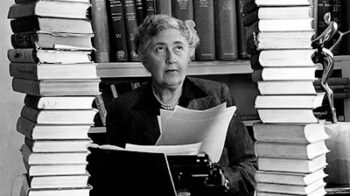
Agatha Christie wrote longhand with no office, and no structure, and desribed the tfirst three or four weeks of starting a new book as sheer agony and self-doubt – and she often wrote the final chapter immediately after the first chapter, so she would know where she was going.
I wrote Not a Penny More, Not a Penny Less when I was bankrupt, terrified, and had no idea where the next bill would come from. The hourglass turned. The sand ran. The book got written.
A few practical notes
- Audit your week. Most adults have 6–10 hours a week genuinely available for writing – usually scattered in 30-minute blocks early morning, late evening, or weekend. Find them honestly.
- Pick one fixed slot and defend it ruthlessly. Same time every day, even if short. Routine outperforms ambition. Half an hour every morning before the kids wake up beats three hours on a ‘free’ Saturday that never arrives.
- Lower the daily target to something you’ll definitely hit. 300 words a day is a novel a year. 100 words a day is a novel in three years. Both are real novels.
- Use waiting time. Train commutes, school pickups, lunch breaks, hospital waiting rooms. Anthony Trollope wrote on trains for forty years. Toni Morrison wrote at 5am with two small children.
- Tell the household what you’re doing. Writing in secret while pretending to do something else exhausts the writer. The protected hour is easier when it’s named.
- Don’t wait for the ‘perfect time’ to write. Children grow up. Jobs intensify. Parents get ill. The novelist who writes in the actual life they have writes more than the novelist who waits for life to clear.