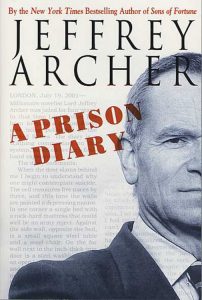
Jeffrey's answer
The honest answer is that I do not stay motivated. I show up. Every day, every session.
Motivation is unreliable. Some mornings I sit at the desk and the words flow. Some mornings I sit at the desk and they do not. The hourglass turns either way. The shift ends either way. The book gets written either way. I do not negotiate with the sand.
What I do, when I am writing, is read. Not to procrastinate — to humble myself.
Some years ago, I was in India. A lady came up to me at a signing and she said, “Kane & Abel is the second-best book I’ve ever read in my life.” I confess I was rather pleased — until I had the wit to ask her, what was the first? She introduced me to a writer I had never heard of, the Austrian novelist Stefan Zweig. I was past seventy when I read him for the first time. I have, since then, read every word he has written. To discover a writer of that quality at that age is one of the privileges of the long career.
When I am writing my own books now, I read Stefan Zweig again. I read him because I know I will never be that good. That sounds bleak. It is not. It is fuel.
The novelist who sits down each morning believing they are already a great writer will produce a worse book than the novelist who sits down each morning knowing they have a long way to go. Zweig humbles me. So does Damon Runyon. So does H. H. Munro — the man who wrote as Saki. There are several writers I keep on my desk, and I read a chapter or a story before I begin work, every morning. Not the same writer every day, and not the same story. I dip in. I take a paragraph. Then I close the book and start my own.
What you are doing is calibrating. You are reminding yourself of what writing can be — at its very best — so that the morning’s work has something to aim at. Without that calibration, the writer drifts. They lower their own bar. They congratulate themselves on a chapter that, in better company, they would have torn up. The writer who reads great writing every morning does not have that problem.
Find the writers who humble you. Read them while you work. Keep them on the desk. The novel gets written either way — but the novel that gets written next to Stefan Zweig is, in my honest experience, a better novel than the one written alone.
The motivation looks after itself once you have set the bar that high.
A few practical notes
- Don’t rely on motivation. Rely on discipline. Motivation is unreliable; the hourglass is reliable.
- Break the book into milestones. Don’t think ‘I have 80,000 words to write’. Think ‘I have to finish chapter 4 by Friday’.
- Reward small wins. Finished a chapter? Take the afternoon off.
- Find your humility text. Jeffrey reads Stefan Zweig. Find the writer who, when you read them, makes you certain you will never be that good. That writer is your fuel, not your enemy.
- Read great prose immediately before you write. Thirty minutes of someone better than you, every morning, calibrates the ear.
- Talk to other writers — but not about your book. Loneliness kills more novels than rejection. A monthly meeting with one or two other writers — even just for coffee — keeps the work feeling possible. Avoid describing your book in detail; the energy you’d have used to write the chapter dissipates if you talk it out.
- Track word count visibly. A spreadsheet, a printed thermometer, an app. Watching the curve climb is its own motivation.
- Writers worth keeping on the desk. Stefan Zweig (start with Beware of Pity or the novella Chess). H. H. Munro / Saki (the Complete Short Stories). Damon Runyon (Guys and Dolls). All cheap second-hand, all humbling.