Jeffrey's answer
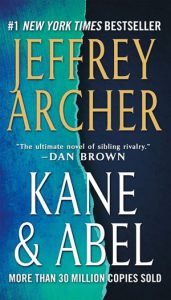
The opening line of Kane & Abel is this:
She only stopped screaming when she died. It was then that he started to scream.
I worked harder on that line than on anything else in the novel. Spent ten times longer on it than on any other line, and ten times longer on chapter one than on any chapter that followed. The reason is simple. The reader has no contract with you yet. They have picked up a book in a shop. They have read one sentence. The whole question of whether they go on to chapter two is being decided in those few seconds. Get the line wrong and nothing else you have written will be read.
What does that line do? It tells the reader, in eighteen words, that this is a book about a death and a birth at the same moment. That a woman has died in childbirth. That a child — a male child — is now alive in the world. And that you, the reader, have stepped into a story whose first scene is grief and noise and the absolute beginning of a life. You cannot put the book down after that line. You may not yet know why, but you cannot.
The first line of chapter two is this:
He was born in a hospital, built by his father.
A different boy. A different birth. A different world. The reader, having met the screaming child of chapter one, now meets a second child — entirely different in circumstance — and they understand, instantly, that this novel is going to be about the parallel lives of two boys born on the same day. Two children. One mother who died screaming in poverty. One mother attended in a hospital her husband owns. The structure of the book reveals itself in two sentences across two chapters.
And then, because the reader is now committed, you can give them the third line of structure — the one that makes the entire book unputdownable:
In the end, one has to die before the other. And the other has to acknowledge him.
Six hundred pages of story sit inside that promise. The whole architecture of Kane & Abel is contained in those three sentences across the opening pages. The opening line gets the reader to chapter two. The chapter two opening reveals the structure. The structural promise tells the reader where the book is going. None of those sentences happened by accident. All of them took weeks to find.
What does this teach the new writer? Three things.
One: a great opening line is a contract. It tells the reader what kind of book this is, and why they should keep reading. That is all. It is not a summary. It is not a thesis. It is an invitation that is impossible to refuse.
Two: the opening of chapter one and the opening of chapter two should work together. Don’t think of the first line in isolation. Think of the opening sequence — the first line, the first paragraph, the first chapter, the line that starts chapter two. They are a single mechanism designed to capture the reader and not let them go. You shouldn’t move on to chapter two until you know you’ve got chapter one embedded and safely there. And the same goes for first lines and last lines.
Three: don’t expect to write the line on draft one. Most opening lines are wrong on the first attempt. The real opening line is usually somewhere in chapter three, after you have written enough of the book to know what it is actually about. I rewrote the opening of Kane & Abel many times across many drafts. The line that survived is not the one I started with.
You can read, or listen to Chapter one of Kane & Abel here – Read Chapter 1 – Listen to Chapter 1.
The greatest opening line in English fiction, for the record, is from a Tale of Two Cities, by Charles Dickens’s:
It was the best of times, it was the worst of times.
In twelve words he establishes a world of contradictions — and hands the reader a contract. The greatest closing line in English fiction is in the same novel, and I will not quote it here in case you have not yet read it. Go and read it. I shall wait – and now I’m inspired to write a Dickens reading list (more soon).
The first line on the opening page of Not a Penny More, Not a Penny Less. my first book is;
Making a million legally has always been difficult. Making a million illegally has always been a little easier.
That is a declaration. It hopefully draws you in. It also, I hope, makes the reader smile slightly. The smile is the second job of an opening line.
You can read, or listen to Chapter one of Penny here – Read Chapter 1 – Listen to Chapter 1.
Write the book. Find the line. Sometimes the line is on page eighty. Bring it back to page one when you have it.
A few practical notes
- The opening line has one job: make the reader read sentence two. It is not a thesis, not a summary, not a mood-piece. It is a hook.
- Think of the opening as a sequence, not a sentence. First line of chapter one + first paragraph + first chapter + first line of chapter two. They work together. Don’t move on to chapter two until you know chapter one is embedded.
- Three patterns that work. (1) A character in the middle of an action that demands explanation. (2) A statement that contradicts a common assumption. (3) A question implied without being asked.
- Examples worth studying aloud. “She only stopped screaming when she died.” — Archer. “It was a bright cold day in April, and the clocks were striking thirteen.” — Orwell. “Mother died today.” — Camus. “It is a truth universally acknowledged…” — Austen. “Call me Ishmael.” — Melville.
- Avoid these openings. Weather (unless the weather IS the story). The protagonist waking up. A long descriptive paragraph before anything happens. A dream sequence.
- Most opening lines are wrong on draft 1. Your real opening line is usually somewhere in chapter 3, after the writer has discovered what the book is actually about. Find it. Move it to page one.
- Spend 10× longer on the opening line than on any other line. Same for the last line. These are the two pieces of work that decide whether the reader buys this book and whether they buy your next one.
- Test it: read the first 100 words to a stranger. Did they want to keep reading? If they shrugged, the opening hasn’t worked yet.