- More
- Back

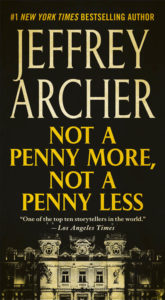
The conned: an Oxford don, a revered society physician, a chic French art dealer, and a charming English lord. They have one thing in common. Overnight, each novice investor lost his life’s fortune to one man. The con: Harvey Metcalfe.
People ask me, more than about any other book I have written, whether it is true.
The honest answer is that Not a Penny More, Not a Penny Less is a novel. Four men, one swindler, and a plan to take back exactly what was stolen from them, not a penny more and not a penny less. I invented the men. I invented the plan. I invented the ending.
But the anger was real. The ruin was real. Which is why I sat down to write it.
Fifty years on, with Pan Macmillan bringing the book back for its anniversary, here are the parts that really happened.
Seventeen different incidents. Some of them cost me my home. One of them I made up entirely, and it is the reason the book exists.
If you’ve not yet read the book, beware: a few mild spoilers below.
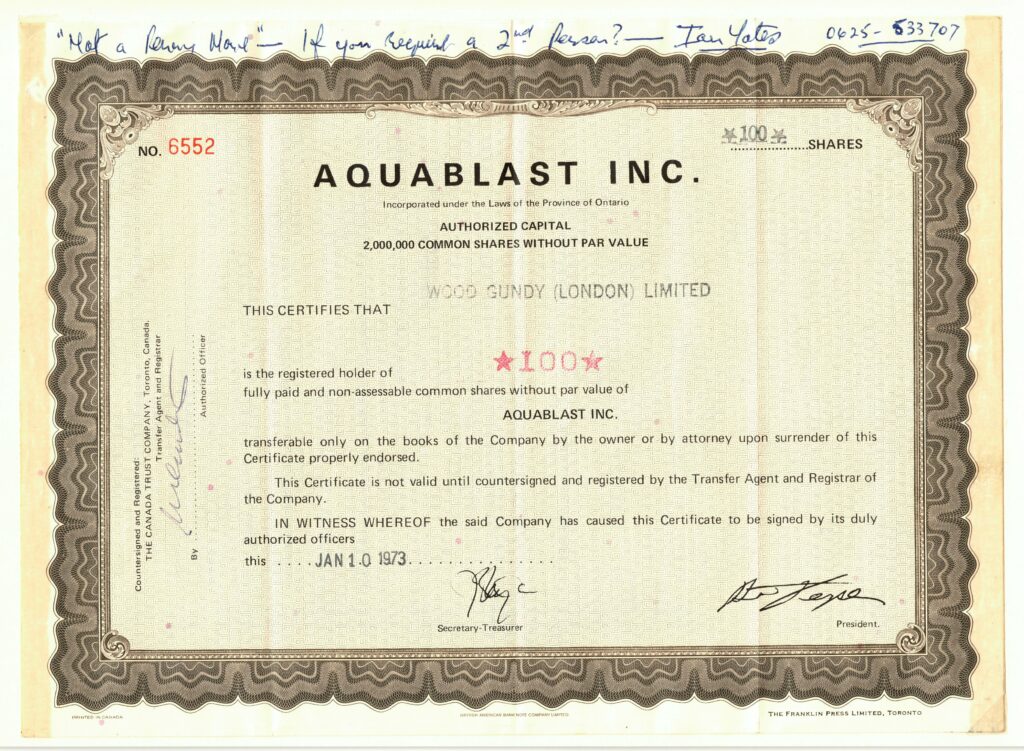
✅ Fact. In 1974 I invested in a Canadian company called Aquablast, presented to me as a wonderful opportunity to make a profit by a vice president at the Bank of Boston. It was not a wonderful opportunity. It was a catastrophe, for me and for everyone else who invested in it.
I lost my home. I had to stand down from Parliament. The debts did not vanish while the investment did.
People ask me where I was when I realised, and what it felt like. That was fifty-two years ago, so it is not possible for me to be wholly accurate. But I can tell you this much: it creeps up on you. You go on believing that it can’t be true. You go on believing, thinking it will turn out all right in the end.
Here is the irony: today it could not happen. Today I would sue the Bank of Boston for the advice from their vice president. I would not have taken the advice of the criminal who went to jail, but I did take the advice of the vice president of a leading American bank. The idea that the Bank of Boston would have ended up on the front page of the newspapers having advised a Member of Parliament to invest in a fraudulent scheme, and that he had been dealing with a crook. I would have undoubtedly got my money back.
That is the irony.
✅ Fact. It is one thing to lose money. It is another to lose your life.
Mary and I were forced to leave our home in London. Our house in The Boltons, one of those smart addresses with their sense of permanence, no longer belonged to us. If you have ever had to sell a home, not because you want to but because you have to, you will know the particular horror of it.
I stood down from Parliament. Whatever the formal phrasing, the reality is simple. I could not ask the public to trust me while my private life was in pieces.
I looked for work. I knocked on doors that did not open. I offered myself for jobs I had never imagined I would have to apply for, and met polite refusals that felt, at the time, like damning verdicts. There is a special sort of humiliation in being told, in effect, that you are not wanted even on the bottom rung, because you appear to be too much of a risk.
✅ Fact, and I do not say it lightly. Mary, my wife, my constant, my anchor, carried far more than her share of the weight during those days. Friends were kind, and kindness matters most when it is offered quietly and meant. But it was Mary who did what needed to be done, without complaint and without theatrics. For our two young sons, William was four and James was two, she took a teaching post in Cambridge. With that came the possibility, blessedly important, of a roof over our heads while I tried to repair the damage I had caused. And my sister Liz moved in and helped us out. Without these two remarkable women, I don’t think I would have made it.
My wife, Mary, was there for all of it, and remembers it rather morey clearly than I do. I asked her to write down what those months were actually like. Here she is, in her own words.
I remember the gestation of Not a Penny More, Not a Penny Less as though it were yesterday.
It was mid-1974, and Jeffrey and I had two-year-old William and newborn James. We had a lovely home in The Boltons, a little doll’s house on the side of number 24, and I was happily halfway through a postdoctoral fellowship at the Royal Institution in London’s Piccadilly.
Then the roof fell in. Jeffrey told me that he had made a large investment in what had turned out to be a fraudulent project and had lost every penny and then some. Months of anguish followed. Jeffrey stepped down as an MP and made a composition with his creditors that still left us with a huge debt, so we knew we would have to sell the house.
Then Jeffrey had what I thought was a truly terrible idea. I should keep the home fires burning, with one toddler and one baby, while he went away for several weeks to write a novel. He went, despite my protests, and returned with a bulky handwritten manuscript and the air of a man who had solved everything. He asked me to have a critical look at it, so after the children had been put to bed, I sat at the kitchen table in The Boltons and read, and read, because I couldn’t put it down.
Red pen in hand, I put in some commas and apostrophes, which is all I have ever contributed to any of Jeffrey’s books, and then the wonderful Debbie Owen took on the project and thanks to her persistence, Penny was published in early 1976.
That was exciting, but it didn’t bring in much cash, and we still had to sell the house. Fortunately, a lifeline appeared in the shape of a teaching opportunity in Cambridge that came with some family accommodation. Thus it was in the summer of 1976 that we drove to a modest new home in Cambridge and a new career for me as a don.
They say when one door closes, another opens, and that was certainly true for us. Cambridge opened a new life for me, and Not a Penny More, Not a Penny Less opened a wholly unexpected one for Jeffrey and a secure future for our boys.
— Mary Archer
That is the question an author cannot answer. Where did you actually get the idea? Because I don’t know.
It probably came in the middle of the night. Four people who would all lose a fortune, stolen from them by one crook.
They would not know each other. But they would come together to steal it back.
Not a penny more, and not a penny less.
✅ Fact, and I shall explain the fat men. At that low point I had been advised there was no money in books, that writing was a luxury few could afford, and that I would be better served doing something sensible, like a job.
I didn’t listen. I decided to write a novel, and of course to dedicate it to Mary and the fat men. That was our nickname for William and James, who were four and two at the time, and who are now rather less fat and considerably more useful.
I did not write it because I believed I was born to be a novelist. I wrote to express my anger in no uncertain terms. I wrote it because I knew, intimately, what it felt like to be taken in by a devious man with a sharp suit and a con artist’s smile.
Fifty years later, my last novel is dedicated to Deborah Owen, the agent who sold my first. There is a certain symmetry to that which I did not plan and rather like.
❌ Fiction. Harvey Metcalfe never existed, and he is not based on one individual.
You develop a character like that, and you might see aspects of him in unscrupulous people you have met, either physically or mentally, and take advantage of it. But Metcalfe is a lot of people put together. He is not one man. I loved him, actually. And it was very interesting that Pierce Brosnan, the great 007 Bond, said that if it was ever made into a film, he wanted to play the villain. He would have done it brilliantly. Brilliantly.
❌ Fiction. First books are always autobiographical. I have never read a first book without thinking, this must have happened to him or her.
I knew a lot of Oxford dons, because of Mary, my wife being one herself. I knew a lot of bankers. I knew a lot of politicians. So yes, I took advantage of that knowledge.
I always say to young authors, for God’s sake, write what you know about. Which is exactly the reason first novels are so autobiographical.
❌ Fiction. Here is the line that matters most on this page, and I want to be clear about it.
Everything that happens to those four men after they are swindled is my imagination. The plan. The chase. Every last penny they take back. None of it happened to me. I did not track down the man who ruined me. I did not out-think him. I did not recover a single penny of the stolen money.
I wrote the book in desperation, yes, but also with considerable pleasure. Because for a few hours each day, while the world outside remained bleak and foreboding, I could control something.
In fiction, the villain does not always win, and those who are cheated can fight back. That is the whole reason the book exists. I could not have my revenge in 1974, so I gave it to four men who did not exist, and I let them achieve it on my behalf. Fortunately, readers have been enjoying it ever since. So, in the end, have I.
✅ Fact. I could not find a title. I had a dozen, but knew none of them was right.
It was my dear friend Adrian Metcalf, the distinguished Olympic silver medallist, who read an early manuscript and told me the title was already on page 88. Not a Penny More, Not a Penny Less. The publishers immediately said it was far too long. It would take up the whole page. There would be no room for my name. And my wife said: ‘Well, don’t worry about that. Everyone remembers the title. No one remembers the author.’
✅ Fact — Fifteen. One after another, before it found a home.
It is quite hard to acquire an agent, and that is true for any author at any time. But I knew the Foreign Secretary, David Owen, and I also knew he was married to an agent. So I said:
‘David, I am not asking for your wife to be my agent. I am asking if she would be kind enough to read the book.’ She read the book, rang me immediately, and said that she would be delighted to represent me. And then had fifteen rejections in a row. But she stuck with it. Thank heavens.
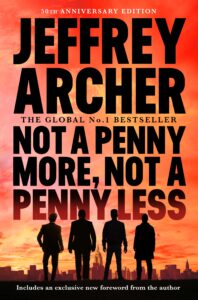
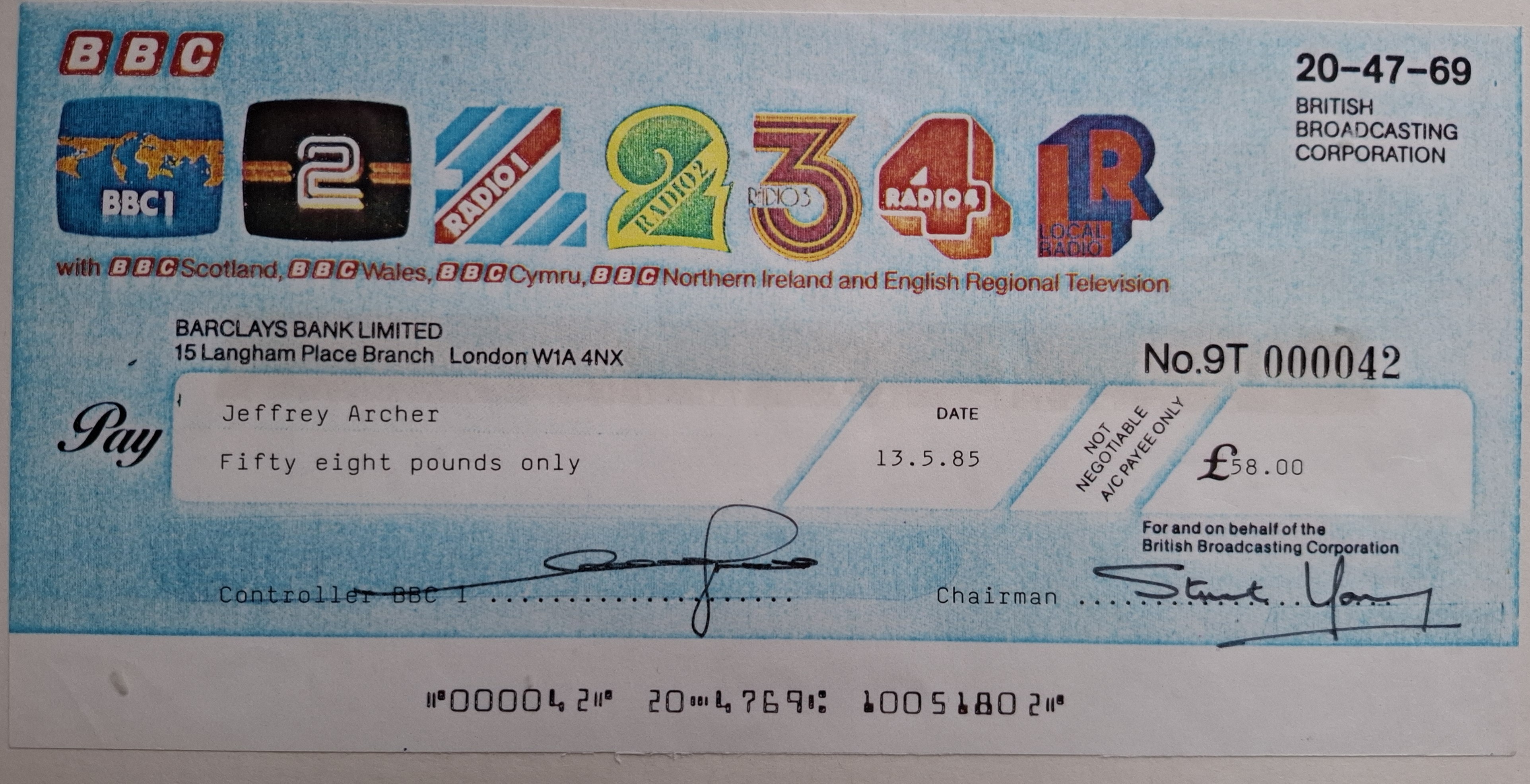
The 50th Anniversary Edition of Not a Penny More, Not a Penny Less, with the Aquablast certificate and the £58 BBC cheque reproduced inside, publishes on 27 August 2026.
✅ Fact. When the book appeared in 1976 it hardly set the world alight. No bestseller list. No critic announcing that literature had been reborn. It sold, how shall I put it, modestly. Three thousand hardbacks, and a few more paperbacks a year later. Enough to keep hope alive. Nowhere near enough to clear the debts.
When you write your first book, you have no idea what you are doing. You are at a loss. You may have written some letters, some papers at university, a thousand words, even fifteen hundred. Then you suddenly sit down and write a novel, and it is a totally new experience.
I did not know where I was going or what I was doing. I assumed, as every fledgling author does, it would be published, which was foolish of me as I later discovered.
Not a Penny More, Not a Penny Less was written by an amateur. I was in debt. I was out of work. I thought the story was a good one, so I got on with it. But I had a lot of luck along the way. And you need luck.
You are on your own. That is the part nobody tells you. Except for your spouse, except for your agent, until you find a publisher, you are on your own. If you are very lucky your publisher will supply an editor, but they have to really believe in the book before they will do that, because that is an investment of time and money.
I now have a team. They decide which car I will get into when I am going to a launch. The cover is a major decision nowadays. They build up for publication day, how we announce it to the press. I have a whole lot of people doing strange things night and day, and my team at HarperCollins is exceptional, and I am a very lucky author. I had none of that in 1974. Nobody was going to give a nearly-bankrupt ex-Member of Parliament the time of day.
✅ Fact. If you want to know what changes in fifty years of writing, do not take my word for it. Read the first chapters. Here is how Not a Penny More, Not a Penny Less begins. It is the prologue, and I was going straight into the action:
‘Jörg, expect seven million from Crédit Parisien in the number two account by six o’clock tonight, Central European Time, and place it overnight with first-class banks and triple-A commercial names. Otherwise invest it overnight in the Eurodollar market. Understood?’
‘Yes, Harvey.’
‘Place one million in the Banco do Brasil, Rio de Janeiro, in the names of Silverman and Elliott, and cancel the call loan at Barclays, Lombard Street. Understood?’
‘Yes, Harvey.’
And here is the opening line of chapter one:
Making a million legally has always been difficult. Making a million illegally has always been a little easier. Keeping a million when you have made it is perhaps the most difficult of all.
Now, that is not a bad opening. But there is nothing in those three lines which I would describe as genuinely original.
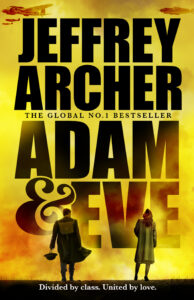
Now read the first two lines of Adam and Eve, my final novel.
He was dreaming when there was a knock on the door. Bill Turner turned over and buried his head in the pillow, still hoping it was a dream, but the knocking ignored his wishes.
I would never have had the courage to write the sentence but the knocking ignored his wishes when I wrote Not a Penny More, Not a Penny Less.
That is after fifty years of experience.
The storytelling is the same. It was always the same. What I lacked was experience that only comes with years of hard graft.

✅ Fact. The BBC dramatised the book, first for radio and later for television, and paid me for the privilege. The cheque was for £58, the price of a television and radio licence at the time. We have reproduced a copy of the cheque in this anniversary edition, alongside the Aquablast share certificate. Two pieces of paper. One represented ruin. The other represented recovery. Between them sits a book.

✅ Fact. People ask me why I kept it. Why I hung the evidence of the worst mistake of my life on a wall, where I have to look at it every day. To remind me what an idiot I was.
It is not a bad thing to be reminded when you have made a complete fool of yourself. And so there it is, up on the wall. Too many people make a mistake and try to pretend it never happened, or put it behind them. Of course you must put it behind you and move on. But do not kid yourself it did not happen. It is printed in this anniversary edition too, so now you can look at it as well.
✅ Fact. I will be honest with you, because an anniversary is no place for myth-making. Not a Penny More kept hope alive. It did not rescue me financially. That took another two books, and the best part of five years, one payment at a time. Deborah Owen took me through to Kane and Abel, which changed my whole life.
Around a quarter of my readers still tell me Not a Penny More is the best thing I have ever done. More than half say Kane and Abel. I have never entirely been able to explain the first group, until a man called Peter Giddy explained it to me. Peter Giddy was Chief Executive at Hatchards bookshop in Piccadilly. When he read Kane and Abel, he told me it was going to sell millions, which was a bit of a shock.
But then he added: ‘It’s not Not a Penny More, Not a Penny Less.’
And I said: ‘What do you mean?’
He said: ‘Not a Penny More, Not a Penny Less is genuinely original. And that is rare.’
✅ Fact. We are currently working with Paramount, who co-own the screen rights to Penny, on a new adaptation. I am not yet allowed to tell you who is writing it or making it, only that they are enormously talented. People are desperate for stories. To quote A. N. Wilson: there are too many mood books without a story. I am a storyteller. So I would be delighted if Not a Penny More, Not a Penny Less was made into a film twice. The BBC did it the first time, and it will be interesting to see if it reaches the screen in my lifetime a second time. The wheel, having very nearly crushed me in 1974, has turned all the way round in my favour.
Adam and Eve, my final novel, is dedicated to Deborah Owen. She is the agent who took this book to fifteen publishers, was turned down fifteen times, and refused to give up on it. She is still very much alive and kicking.
Fifty years and thirty-one novels separate my first book from my last. It seemed to me there was only one name that belonged at the front of the last one.