Jeffrey Archer’s Top 10 Unputdownable Con Artist Books

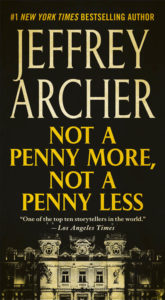
Celebrating 50 years of Not a Penny More, Not a Penny Less

I know a thing or two about being swindled.

In 1974, I invested in what I was assured was a wonderful opportunity, an exciting Canadian venture called Aquablast, presented to me by a vice president at the Bank of Boston. It turned out to be catastrophe for all of us who invested in it. I lost my home, I stood down from Parliament, and my wife Mary took a teaching post in Cambridge so we could keep a roof over our heads.

There are few sensations quite like realising you have been taken in. Your first reaction is disbelief. Then, if you are honest with yourself, embarrassment. And finally the anger, white-hot and sleepless, because you begin to understand that the swindler is not merely taking your money. He is taking your dignity.

Out of that anger came Harvey Metcalfe, the villain of my first novel, Not a Penny More, Not a Penny Less. Harvey did not twirl his moustache. He simply believed he was entitled. Entitled to win, entitled to profit, entitled to treat other people as stepping stones. I had met such men. I’m sure you have too.

When it comes to bad guys, the truth is the public like them more than the good guys. They love reading about them. Harvey Metcalfe, who has robbed those four nice young men of their money, is the one everybody wants to follow. Of course they want to see him beaten in the end. But he is who they are following.

Some years after the book came out, Pierce Brosnan rang me. He said, “I want to play Metcalfe.” He didn’t want to play the hero. He wanted to play the villain. I think villains are often much more fun to play, to perform, than nice, sweet, delightful, good human beings. Shakespeare, of course, was a genius at this.

Out of that same anger came the four men who decided to take back what was stolen from them, not a penny more, and not a penny less. That line has always sounded to me like both a promise and a threat. It draws a moral boundary. Revenge, yes, but with a compass. Justice, yes, but without becoming dishonest.

A few years later, when I had finished writing Kane & Abel, I went into Hatchards. Peter Giddy, a very distinguished managing director, had loved it. He said to me, “Jeffrey, Kane & Abel will go to number one right across the world. It’s going to change your career.” Then he looked at me and said, “But it’s not Not a Penny More, Not a Penny Less. Not a Penny More, Not a Penny Less is original. You can’t compare it with anything else.”

I have thought about that conversation many times in the half-century since. Peter was right. Kane & Abel did go to number one. But Not a Penny More is the book I am asked about more than any other. And what gave it its life, what gives any book its life in the end, is that it was original.

Fifty years on, I find the con artist has never gone out of fashion. If anything, the breed has evolved. The swindler in a sharp suit has been joined by the tech founder with a blood-testing machine that doesn’t work, the financier whose Ponzi scheme swallowed the savings of his own friends, and the gentleman burglar who has been charming readers since 1899.

So, to mark the 50th anniversary of Not a Penny More, I have chosen the ten books, fiction and non-fiction, classic and modern, that I believe are the finest ever written about con artists and the people they prey upon. Some of these books taught me how to plot. Some taught me how to build a villain. And one or two reminded me, when I needed reminding, that the best revenge is living well.

Ten books, in the order in which they were written. I promise you, the hard part was stopping at ten.

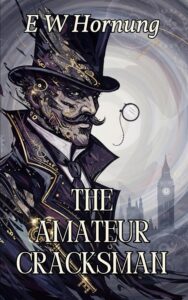
1. Raffles: The Amateur Cracksman by E.W. Hornung (1899)

The original gentleman burglar. E.W. Hornung, who happened to be Arthur Conan Doyle’s brother-in-law, created A.J. Raffles in 1899 and in doing so invented an entire genre. Raffles is a celebrated cricketer, a darling of London society, and a burglar of extraordinary nerve. He steals not because he must. He steals because he can, and because, like all the best rogues, he finds respectability rather dull.

What I love about Raffles is the code. He has one. He will steal from the rich, but he will not betray a friend. He will break into a country house, but he will keep his word. That moral line, crooked but real, is something I recognised when I was writing Harvey Metcalfe’s victims. My four men have a code too. Not a penny more, not a penny less.

A confession about Raffles. The world has moved on since 1899. When I was a child, you robbed banks. Nobody robs banks nowadays. The con has evolved. Sharper suits, bigger sums, more sophisticated lies. Raffles belongs to a vanished world where a gentleman in an evening jacket could pocket a pearl necklace and slip out before the butler noticed. That is part of his charm. And it is why the books still hold, a century and a quarter after they were written. They are a period piece about craft, and the craft is what endures.

Conan Doyle disapproved of Raffles, feeling that Hornung was glorifying crime. He may have had a point. But readers have adored the character for more than a century, and I confess I am among them.


Raffles: The Amateur Cracksman

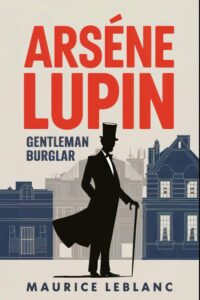
2. ARSÈNE LUPIN, GENTLEMAN BURGLAR by Maurice Leblanc (1907)

If you have watched the Netflix series — and judging by the numbers, half the world has — you already know the name. But I would urge you to go back to the source. Leblanc created the original gentleman thief more than a century ago, and the character has never been bettered for sheer audacity.

What makes Lupin irresistible is not merely that he steals. It is how he steals — with wit, elegance, and a sense of theatre that makes you root for him even when you know you shouldn’t. He is the con artist as performer, and every page crackles with the pleasure of watching a master at work.

I have always believed that the best villains are the ones you secretly admire. Leblanc understood this long before the rest of us.


ARSÈNE LUPIN, GENTLEMAN BURGLAR

3. The Big Con by David Maurier (1940)

This is the non-fiction Bible of the confidence game, and if you have ever seen The Sting — one of the greatest films ever made — you have David Maurer to thank. The film’s creators drew so heavily on this book that Maurer sued them, and I must say I rather sympathise.

Maurer was a linguistics professor who spent years among real con men, learning their language, their methods, and their remarkable discipline. What emerges is a portrait of the “big con” as a craft — almost an art form — requiring teamwork, timing, and an intimate understanding of human greed.

I read this book after I had been swindled, and I confess it was an uncomfortable education. I recognised rather too many of the techniques.


The Big Con

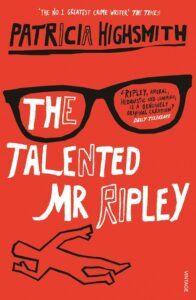
4. The Talented Mr Ripley by Patricia Highsmith (1955)

Highsmith did something in this novel that very few writers have the nerve to attempt: she made the villain the hero. Tom Ripley is a murderer, a forger, and a thief — and you cannot stop reading about him.

The genius of the book is psychological. Ripley does not steal because he is greedy. He steals because he wants to become someone else — someone richer, more cultured, more admired. It is an identity theft in the deepest sense, and Highsmith writes it with a cool, unsettling precision that stays with you for weeks.

If Harvey Metcalfe is the con artist who believes he is entitled, Ripley is the con artist who believes he is invisible. Both are dangerous. Both are unforgettable.


The Talented Mr Ripley

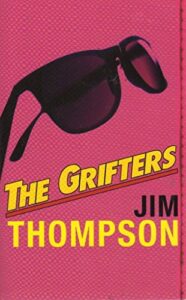
5. The Grifters by Jim Thompson (1963)

I end with the darkest book on this list. Thompson writes about the underworld of small-time American con artists — the grifters — and there is no glamour here, no gentleman thieves, no witty repartee. Just desperation, greed, and the awful mechanics of people using each other.

It is a corrective. After nineteen books that celebrate the cleverness and style of the con, Thompson reminds us what it actually looks like at the bottom: shabby, cruel, and ultimately self-destructive. If Lupin is the con artist you admire, the Grifters are the con artists you pity.

And that contrast — between the elegance of the fiction and the ugliness of the reality — is, in the end, why I wrote Not a Penny More, Not a Penny Less. Because when you have been on the wrong end of a con, you don’t want style. You want justice.


The Grifters

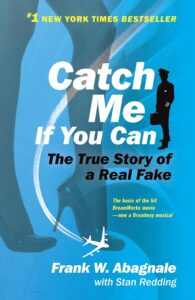
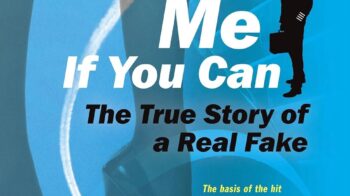
6. Catch Me If You Can by Frank Abagnale (1980)

The true story of a teenager who impersonated a pilot, a doctor, and a lawyer — and cashed millions in fraudulent cheques before the FBI caught up with him — is so outrageous that it reads like fiction. Spielberg turned it into a film with Leonardo DiCaprio, and quite right too.

What fascinates me about Abagnale is the sheer nerve. He did not have a team. He did not have technology. He had charm, confidence, and the understanding — which every great con artist shares — that people see what they expect to see. If you dress like a pilot and walk like a pilot, nobody asks for your licence.

I was swindled by a man who understood this principle rather too well.


Catch Me If You Can

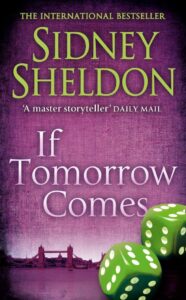
7. If Tomorrow Comes by Sidney Sheldon (1985)

Sidney Sheldon understood something that too few thriller writers grasped at the time: a woman can be the smartest person in the room. Tracy Whitney is framed, imprisoned, and stripped of everything — and then she becomes the most brilliant con artist in the world.

This is the book that proved the revenge-heist story works just as well with a female lead, and Sheldon’s plotting is relentless. If you have read Not a Penny More and enjoyed the satisfaction of watching the swindled fight back, Tracy Whitney will feel like a kindred spirit.


If Tomorrow Comes

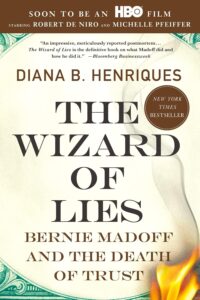
8. The Wizard of Lies by Diana Henriques (2011)

Bernie Madoff swindled his friends, his relatives, and his investors out of sixty-five billion dollars in the largest Ponzi scheme in history. Diana Henriques of the New York Times wrote the definitive account, drawing on unprecedented access — including Madoff’s first interviews from prison.

What makes this book so chilling is the intimacy of the betrayal. Madoff did not swindle strangers. He swindled the people who trusted him most — people who had dinner at his table, who introduced him to their families, who believed in him precisely because he seemed so trustworthy. The suicides, the shattered charities, the fractured families that followed his arrest are devastating to read.

HBO turned it into a film with Robert De Niro, and rightly so. But the book is better, because Henriques asks the question the film cannot quite answer: how does a man live with himself while destroying the lives of everyone who loves him? I don’t know the answer. But I know the question haunts anyone who has ever been on the wrong end of a con.


The Wizard of Lies

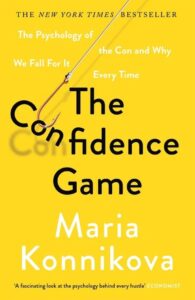
9. The Confidence Game by Maria Konnikova (2016)

Konnikova is a psychologist, and this book explains why we fall for cons — the cognitive biases, the emotional vulnerabilities, the deep human need to trust. It is the only book on this list that treats the con as a science rather than a story, and it is essential reading.

After finishing it, I understood something I had resisted for years: the reason I was swindled in 1974 was not that I was stupid. It was that I am human. Con artists exploit the best parts of our nature — our optimism, our trust, our desire to believe. That is what makes them so dangerous, and so difficult to forgive.


The Confidence Game

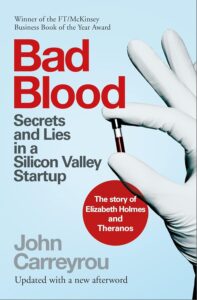
10. Bad Blood by John Carreyrou (2018)

If you want proof that truth is stranger than fiction, read this book. Elizabeth Holmes convinced some of the most powerful people in America that she had invented a machine that could run hundreds of medical tests from a single drop of blood. She hadn’t. The machine didn’t work. And by the time the truth emerged, she had raised nearly a billion dollars.

Carreyrou’s reporting is meticulous and devastating. What makes Bad Blood essential reading for anyone interested in the con is the scale of the deception — and the reminder that the bigger the lie, the more people want to believe it.

I recognise the pattern. I fell for a smaller version of it in 1974.


Bad Blood